Chapter 4: Impedance tubes and \(k\ell \ll 1 \) impedances
- ☸ How is the impedance \(Z_n\) of an unknown material measured in an impedance tube, where the impedance of the medium (e.g., air) is \(Z_0\)?
- How is the magnitude \(|R|\) of the reflection coefficient \(R\) found?
- How is the phase \(\psi\) of \(R = |R|e^{j\psi}\) determined?
- How is the attenuation coefficient \(\alpha\) measured?
- What is the relationship between impedance, reactance, resistance, inductance, and capacitance?
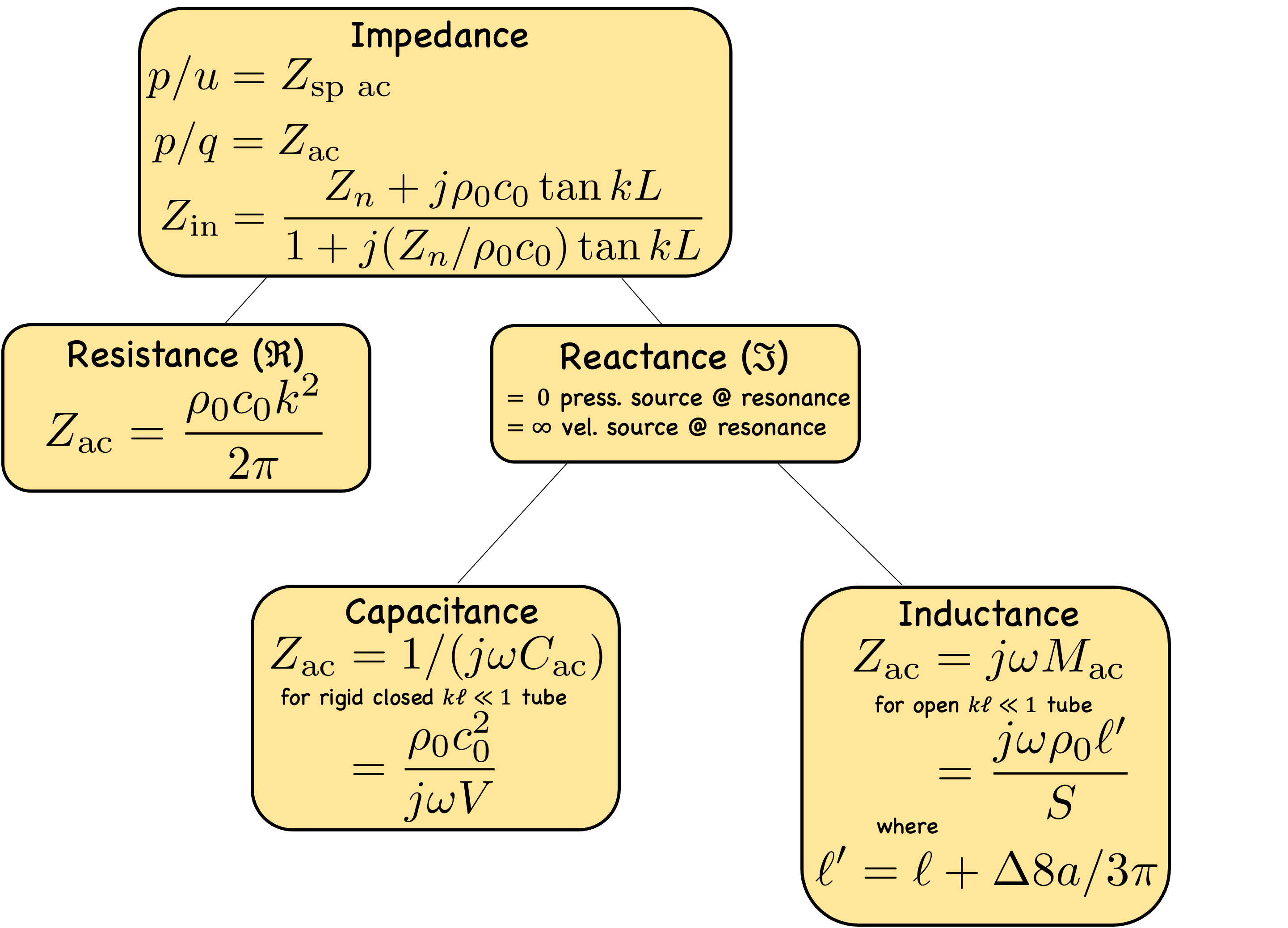
- For a pressure source, the impedance at the resonance frequency goes to what quantity?
- For a velocity source, the impedance at the resonance frequency goes to what quantity?
- Derive \(Z_\text{ac}\) for mass-like and spring-like behaviours, appealing to Newton's law of motion and Hooke's constitutive relation.
- In question (1) of this section, \(Z_n\) was calculated by evaluating \(P/U\) at \(d=0\) (or \(x = L\) which corresponds to the location of the load). Now calculate the input impedance \(Z_\text{in}\), which is \(P/U\) at \(d=L\) (or \(x=0\)) in terms of \(Z_n\), the impedance of the load. Let \(P(x) = A \cos{kx} + B\sin{kx}\).
- In the previous problem it was found that the input impedance in terms of the impedance of the load is \begin{equation}\label{Input impedance}\tag{2} \frac{Z_\text{in}}{\rho_0 c_0} = \frac{Z_n/\rho_0 c_0 + j\tan kL}{1 + j(Z_n/\rho_0 c_0) \tan kL} \,. \end{equation} What are the three special cases that follow from equation (\ref{Input impedance})?
- Use equation (\ref{Input impedance}) to derive \(Z_\text{in}\) for a short closed cavity. "Short" means \(kL \ll 1\) and "closed" means \(Z_n \to \infty\). Find the acoustic impedance also.
- What is the end correction for a flanged tube? Qualitatively describe the origin of the end correction. What about the end correction for an unflanged tube?
- Use equation (\ref{Input impedance}) to find the input impedance \(Z_\text{in}\) for short open cavity, where "short" means \(kL \ll 1\) and "open" means \(Z_n \to 0\). Also find the acoustic impedance.
- Calculate the acoustic impedance of a Helmholtz resonator. What is the resonance frequency for a pressure source?
- Provide a few definitions of the quality factor \(Q\).
- Write the impedance of a bubble using the low-\(ka\) approximation of the spherical wave impedance and find the resonance frequency in terms of the ratio of specific heats, \(\gamma\). Note from the definition of adiabatic sound speed that \(\rho_0 c_0^2 = \gamma p_0\).
- What is the acoustic impedance of an orifice (a hole in a plate)?
- Derive the \(R\), \(T_2\), and \(T_3\) for a side branch, where each pipe has a different cross-sectional area and contains a different medium. Let the incident wave originate from a region with cross-sectional area \(S_1\), and let where the two branches have cross-sectional area of \(S_2\) and \(S_3\) respectively.
- How can a Helmholtz resonator be used as a filter?
- The reflection and transmission coefficients for the three-medium problem are \begin{align} R &= \frac{(1-Z_1/Z_3)\cos k_2\ell + j(Z_2/Z_3-Z_1/Z_2)\sin k_2\ell}{(1+Z_1/Z_3)\cos k_2\ell + j(Z_2/Z_3+Z_1/Z_2)\sin k_2\ell}\label{3R} \tag{3}\\ T &= \frac{2}{(1+Z_1/Z_3)\cos k_2\ell + j(Z_2/Z_3+Z_1/Z_2)\sin k_2\ell}\label{3T} \tag{4} \end{align} Find \(R\) and \(T\) for the special cases of \(k_2 \ell = n\pi\) and \(k_2 \ell = (2n-1)\pi/2\).
- How do equations (\ref{3R}) and (\ref{3T}) change for a homogeneous medium of three different cross-sectional areas \(S_1\), \(S_2\), and \(S_3\)?
- Use equation (\ref{3T}) to find \(T\) and \(\text{TL}\) for the case that \(k_2 \ell \ll 1\) and \(Z_2 \gg Z_1 = Z_3\). What might these conditions represent physically?
- Take the high-frequency limit of the \(\text{TL}\) obtained in the previous quesiton. How many \(\text{SPL dB}/\text{octave}\) does this correspond to? What is this "law" referred to as? Which frequencies therefore tend to pass through a wall? How much more massive must the wall be to make the sound passing through a wall half as loud?