Chapter 5: \(R\)-\(T\) for oblique incidence
- Consider wave propagation at the interface of two media, where the medium on the left is denoted "1" and has impedance \(Z_1\), and the medium on the right is denoted "2" and has impedance \(Z_2\), as shown below. The the horizontal direction is the rectangular \(x\)-coordinate and the vertical direction is the rectangular \(y\)-coordinate.
 \begin{align}
p_i &= A_i \exp{(-jk_1x\cos\theta_i - jk_1y\sin\theta_i)}\label{pi} \tag{5}\\
p_r &= A_r \exp{(jk_1x\cos\theta_r - jk_1y\sin\theta_r)}\label{pr} \tag{6}\\
p_t &= A_t \exp{(-jk_2x\cos\theta_t - jk_2y\sin\theta_t)}\label{pt} \tag{7}\\
\end{align}
What is the condition on the pressure at the boundary? Use this condition to derive the law of reflection and Snell's law.
\begin{align}
p_i &= A_i \exp{(-jk_1x\cos\theta_i - jk_1y\sin\theta_i)}\label{pi} \tag{5}\\
p_r &= A_r \exp{(jk_1x\cos\theta_r - jk_1y\sin\theta_r)}\label{pr} \tag{6}\\
p_t &= A_t \exp{(-jk_2x\cos\theta_t - jk_2y\sin\theta_t)}\label{pt} \tag{7}\\
\end{align}
What is the condition on the pressure at the boundary? Use this condition to derive the law of reflection and Snell's law.
- There is another condition at the interface. What is it? Use it to derive the reflection and transmission coefficients \(R\) and \(T\).
- Derive the power reflection and transmission coefficients \(r\) and \(\tau\). What is the cheap way of deriving \(\tau\)?
- What is the fancy name for the angle at which sound transmits perfectly from one medium to the next? Derive an expression for this angle.
- What is the condition for total internal reflection? What is name of the minimum angle \(\theta_i\) at which total internal reflection occurs? Find that angle.
- Based on the figure below, which is larger: \(c_1\) or \(c_2\)?
 And from which direction of wave propagation does there exist a critical angle: \(c_1\) to \(c_2\), or \(c_2\) to \(c_1\)?
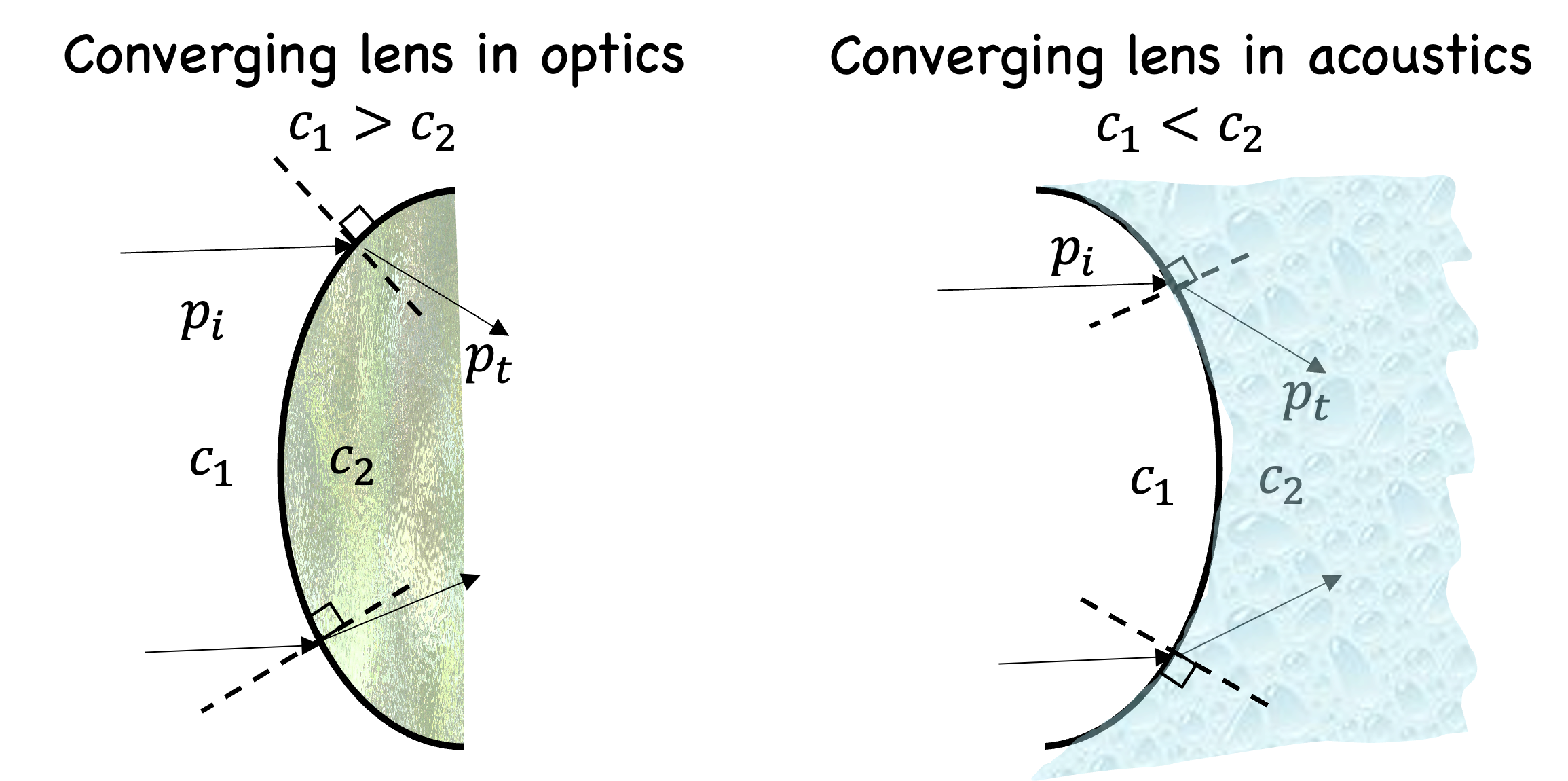
- In optics, a converging lens generally has a convex shape \(()\), while a diverging lens generally has a concave shape \()(\). But in acoustics, a converging lens generally has a concave shape \()(\), while a diverging lens generally has a convex shape \(()\). Why is this?
This is because in optics, light travels faster in air than in the material of the lens (e.g., a glass lens in air), while in acoustics, sound travels slower in air than the material of the lens (e.g., a water lens in air). For example, a converging lens bends light towards the local normal in the lens, so a convex shape is used in optics, while a concave shape is used in acoustics:
- For \(\theta_i >\theta_\text{crit}\), what happens to equation (\ref{pt})? What is the term for the transmitted waves in the \(x\)-direction?
- ☸ For \(\theta_i >\theta_\text{crit}\), what happens to the reflection coefficient \[R = \frac{Z_2\cos\theta_i - Z_1\cos\theta_t}{Z_2\cos\theta_i + Z_1\cos\theta_t}?\] Use the force-free boundary condition on the interface \(1+R=T\) to also determine what happens to the transmission coefficient for \(\theta_i >\theta_\text{crit}\). Find \(|T|\) as well. Use Dr. Blackstock's notation \(b\equiv\sqrt{(c_2/c_1)^2\sin^2\theta_i - 1}\).
- The mass law for oblique incidence was covered in class by considering the wall in two different ways. Qualitatively describe the boundary conditions at the wall and how one would obtain the reflection and transmission coefficients in both cases.
- How does one calculate the power transmission coefficient \(\bar{\tau}\) for a composite wall, i.e., a wall with windows, doors, etc. How does one then calculate the composite transmission loss \(\text{TL}_\text{comp}\).