Chapter 8: Sound in stratified media
- What is primarily responsible for the stratification of the atmosphere? In which governing equation does this manifest?
- Simplify the 1D momentum equation with a body force \(\rho (u_t + uu_z)+ P_z = -\rho g\) for a motionless fluid, i.e., \(u=0, P=p_0, \rho=\rho_0\), to obtain \begin{equation}\label{gravity} \frac{dp_0}{dz} = -\rho_0 g\,. \tag{8} \end{equation} What are two different assumptions on \(\rho_0\) that allow for simple solutions of equation (\ref{gravity})?
- Assume that the density is constant i.e., \(\rho_0 \neq \rho_0(z)\), and thus integrate equation (\ref{gravity}). Let \(\bar{p}_0 = p_0(z=0)\) be the sea-level pressure. What is the scale height of the atmosphere? Use the adiabatic relation \(c_0^2 = \gamma \bar{p}_0/\rho_0\) to eliminate density from the final expression.
- Next assume that the temperature is \(T_0\) at all heights. Why is "isothermal" not the best word choice for such an atmosphere? Combine the ideal gas law \(\rho_0 = p_0/RT_0 = \gamma p_0/c_0^2\) with the definition of the scale height \(c_0^2 = H\gamma g\) and eliminate \(\rho_0\) in equation (\ref{gravity}), and thus obtain \begin{equation}\label{integrateher} \frac{dp_0}{dz} = -\frac{p_0}{H}\,. \tag{9} \end{equation} Solve equation (\ref{integrateher}) for \(p_0\).
- Linearize the 1D continuity equation, \(\partial\rho/\partial t + (\rho u)_z = 0\), for the case of a variable ambient density \(\rho_0= \rho_0(z)\).
- Linearize the 1D momentum equation with a body force, \(\rho(\partial u /\partial t + u\partial u/\partial z) + \partial P/\partial z = -\rho g\), where \(\rho_0= \rho_0(z)\). Simplify the result by invoking equation (\ref{gravity})
- In a stratified medium, what assumption is made about the local entropy? Use this assumption to simplify the state equation \[\frac{DP}{Dt} = \bigg(\frac{\partial P}{\partial \rho}\bigg)_s \frac{D\rho}{Dt} + \bigg(\frac{\partial P}{\partial s}\bigg)_\rho \frac{Ds}{Dt}\,,\] and recall that \(Df/Dt = \partial f/\partial t + u\partial f/\partial z\) for an arbitrary quantity \(f\).
- Equation (\ref{conters}) is used to eliminate density from the right-hand side of equation (\ref{staters}), giving \(\partial p/\partial t + u\partial p_0/\partial z = -c_0^2\rho_0 \partial u/\partial z\). Using equation (\ref{gravity}) to eliminate the static pressure gradient on the left-hand side gives \(\partial p/\partial t - g\rho_0 u = -c_0^2\rho_0 \partial u/\partial z\). Taking the \(z\) derivative with respect to this result gives \begin{equation}\label{combiners}\tag{v} \frac{\partial^2 p}{\partial z\partial t} - g\frac{\partial}{\partial z}\bigg[\rho_0 \frac{\partial u}{\partial z}\bigg] = -\frac{\partial}{\partial z}\bigg[c_0^2\rho_0 \frac{\partial u}{\partial z}\bigg]\,. \end{equation} Meanwhile, rearranging equation (\ref{momers}) and taking the time derivative gives \(\partial^2 p/\partial z\partial t + g\partial\rho'/\partial t = -\rho_0 \partial^2 u/\partial t^2\). Combining this equation with equation (\ref{conters}) to eliminate \(\partial\rho'/\partial t\) gives \begin{equation}\label{combiners2}\tag{vi} \frac{\partial^2 p}{\partial z\partial t} - g\frac{\partial}{\partial z}(\rho_0 u) = -\rho_0\frac{\partial^2 u}{\partial t^2}\,. \end{equation} Subtract equation (\ref{combiners}) from equation (\ref{combiners2}) to obtain \begin{equation}\label{horny}\tag{10} \frac{\partial^2 u}{\partial z^2} + \frac{\partial (\rho_0c_0^2)/\partial z}{\rho_0c_0^2}\frac{\partial u}{\partial z} - \frac{1}{c_0^2}\frac{\partial^2 u }{\partial t^2} = 0, \end{equation} the wave equation for plane waves in an inhomogeneous medium.
- In what limit does equation (\ref{horny}) recover \(\frac{\partial^2 u}{\partial z^2} - \frac{1}{c_0}\frac{\partial^2 u }{\partial t^2}\)? How is \(\frac{\partial^2 u}{\partial z^2} - \frac{1}{c_0}\frac{\partial^2 u }{\partial t^2}\) different from the "normal" 1D wave equation?
- What is striking about equation (\ref{horny})?
- What kind of atmosphere renders equation (\ref{horny}) identical in form to the Webster horn equation for an exponential horn?
- Insert the trial solution \(u = \bar{u}_0 \exp[j(\omega t - kz)]\) into \(u_{zz} + \frac{1}{H} u_z - \frac{1}{c_0^2} u_{tt} =0\) to obtain \(|u(z)|\), where \(\bar{u}_0\) is the particle velocity amplitude at sea level. What is remarkable about this result? Derive this result directly from the conservation of energy.
- Water is most dense at \(4^\circ \text{ C}\). What is the temperature of the deep ocean?
- Explain the various features in the ocean sound speed profile.
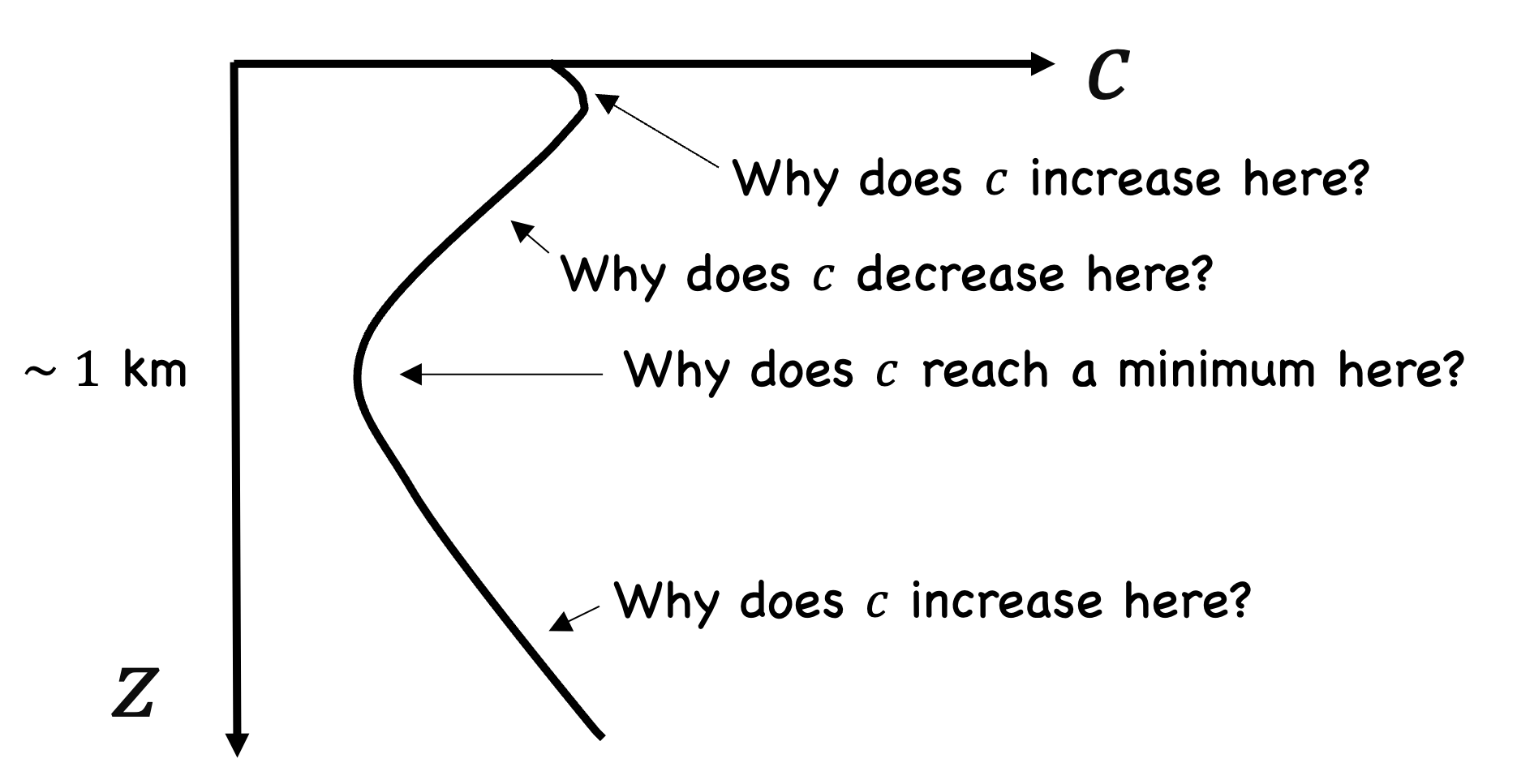
Adapted from figure 8.2(b) from Fundamentals of Physical Acoustics by David T. Blackstock
List any names for the features labeled in the figure. - For what frequencies is ray theory a good approximation? What are some other assumptions made when treating sound as rays? How does the amplitude of sound in a ray depend on the cross-sectional area of a ray?
- How are angles defined in ray theory? Write Snell's law in this convention.
- Since Snell's law applies everywhere in a stratified medium, \(\cos(\theta)/c(\theta)\) is a constant. Find an expression for \(dc/d\theta\).
- ☸ Define the sound speed gradient to be \(g\equiv dc/dz\). Define the radius of curvature \(R_c \equiv ds/d\theta\). Use the chain rule, the definition of the sound speed gradient, and the differential form of Snell's law \(dc/d\theta\) from the previous problem, to express \(R_c \) in terms of \(\theta\), \(g\), and \(c\). Note that \(dz/ds = \sin(\theta)\).
- If \(g<0\), what is the sign of \(R_c\)? In that case, does the ray bend toward or away from the surface? What about for \(g>0\)?
- The figure below is adapted from Blackstock's figure 8.8. It shows that a ray in a linear sound speed profile traverses a depth and range of
\begin{align}
\Delta z &= R_c(\cos\theta_i - \cos\theta)\label{skippy} \tag{11}\\
\Delta r &= R_c(\sin\theta - \sin\theta_i)\,. \label{skippy2} \tag{12}
\end{align}
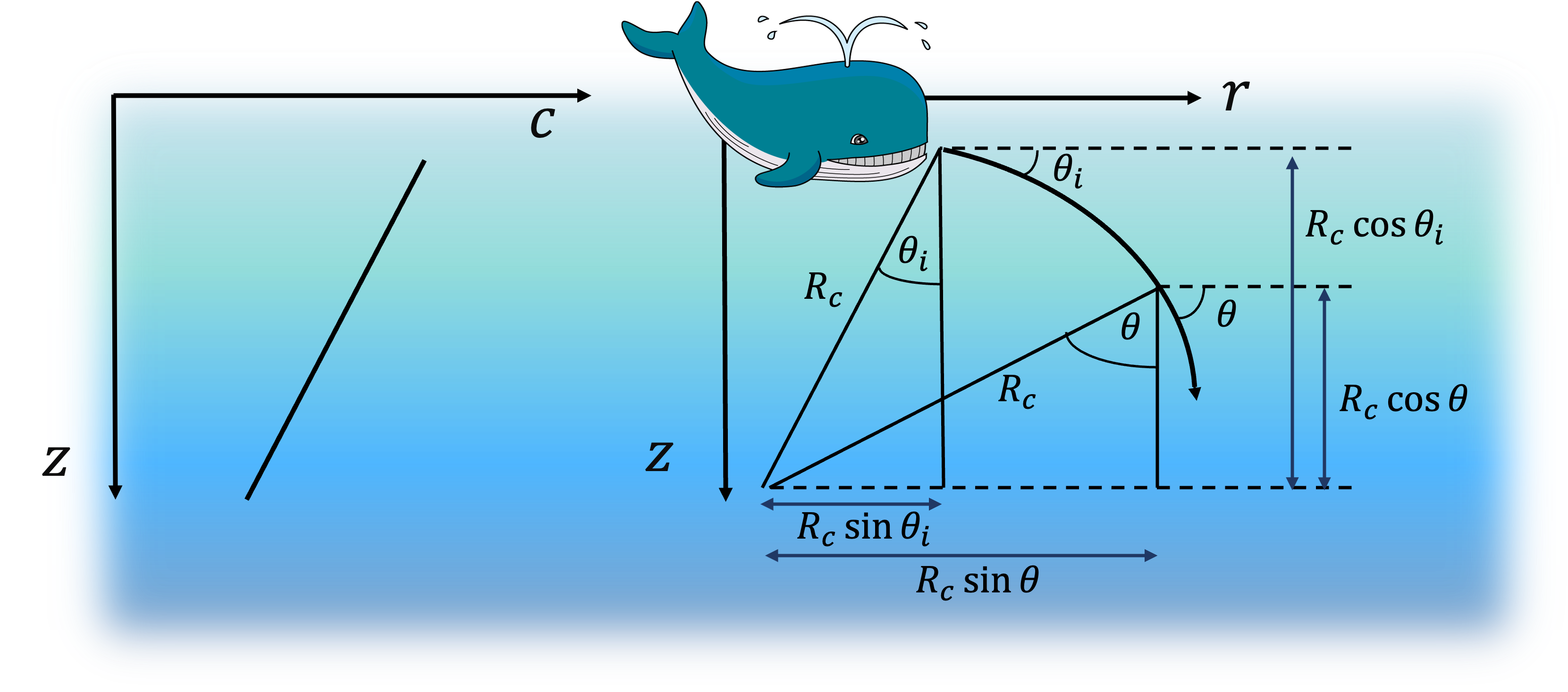 Find the distance from the source to the vertex by setting \(\theta=0\) and using the expression for \(R_c\) found in problem 18.
- For \(dc/dz = g>0\), it is possible for the sound rays to bounce (or "skip", hence \(\theta_s\)) off the the surface, as shown in the figure below adapted from Blackstock's figure 8.10:
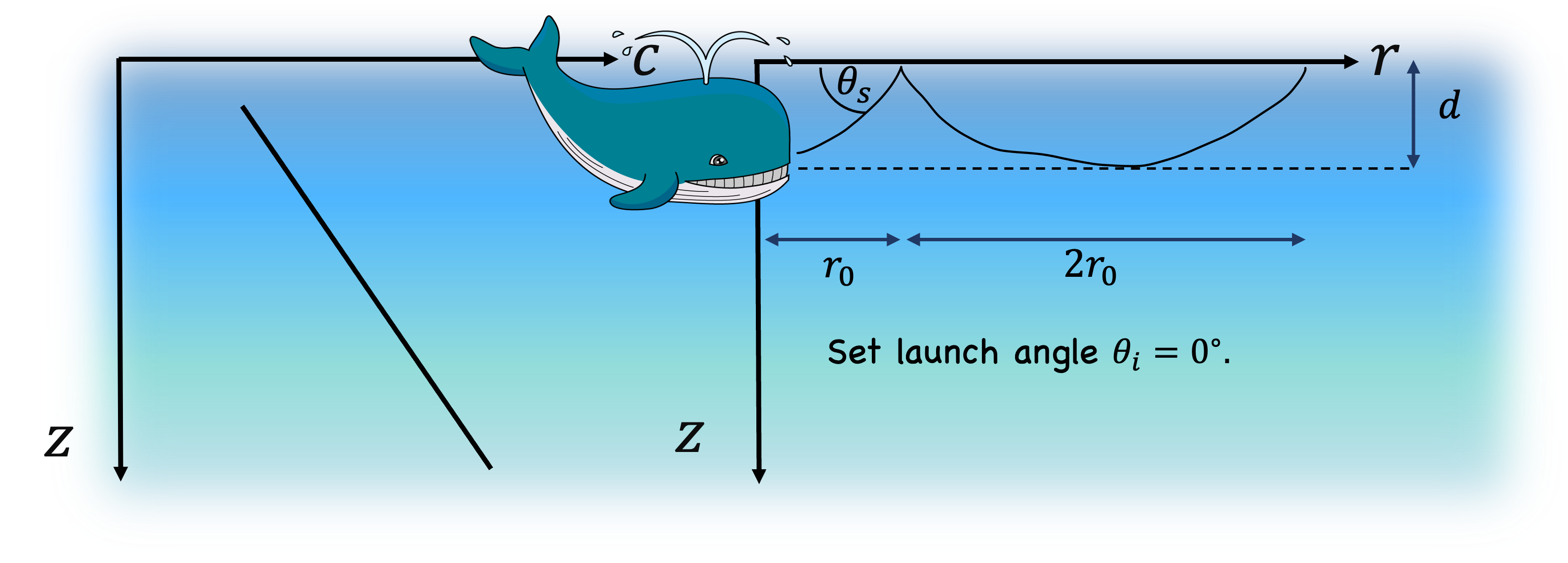 In this case, setting \(\theta_i=0\) and using equations (\ref{skippy})
and (\ref{skippy2}),
\begin{align*}
-d &= R_c(1 - \cos\theta_s)\\
r_0 &= R_c \sin\theta_s\,.
\end{align*}
Solve for \(r_0\), which is called the cycle distance.
In this case, setting \(\theta_i=0\) and using equations (\ref{skippy})
and (\ref{skippy2}),
\begin{align*}
-d &= R_c(1 - \cos\theta_s)\\
r_0 &= R_c \sin\theta_s\,.
\end{align*}
Solve for \(r_0\), which is called the cycle distance.
- Is it possible for a ray to execute a closed trajectory, i.e., make a loop? Why are or why not?
- Obtain the phase speed and group speed given the dispersion relation \(k = \omega n(\omega)/c_0\).