Chapters 13-14: Diffraction
This section is almost entirely based on my class notes from Dr. Hamilton's Acoustics II course. The derivations are challenging, so hints/outlines have been provided. It is more important to understand the underlying concepts.
- How does the quantity \(R = |\vec{r}- \vec{r}_0|\) relate a sound source to the listener?
If the source is located at \(\vec{r}_0\) and the listener is located at \(\vec{r}\), \(R = |\vec{r}- \vec{r}_0|\) is the distance between source and listener. Its shorthand when appearing in the argument of a Green's function is \(\vec{r}|\vec{r}_0\).
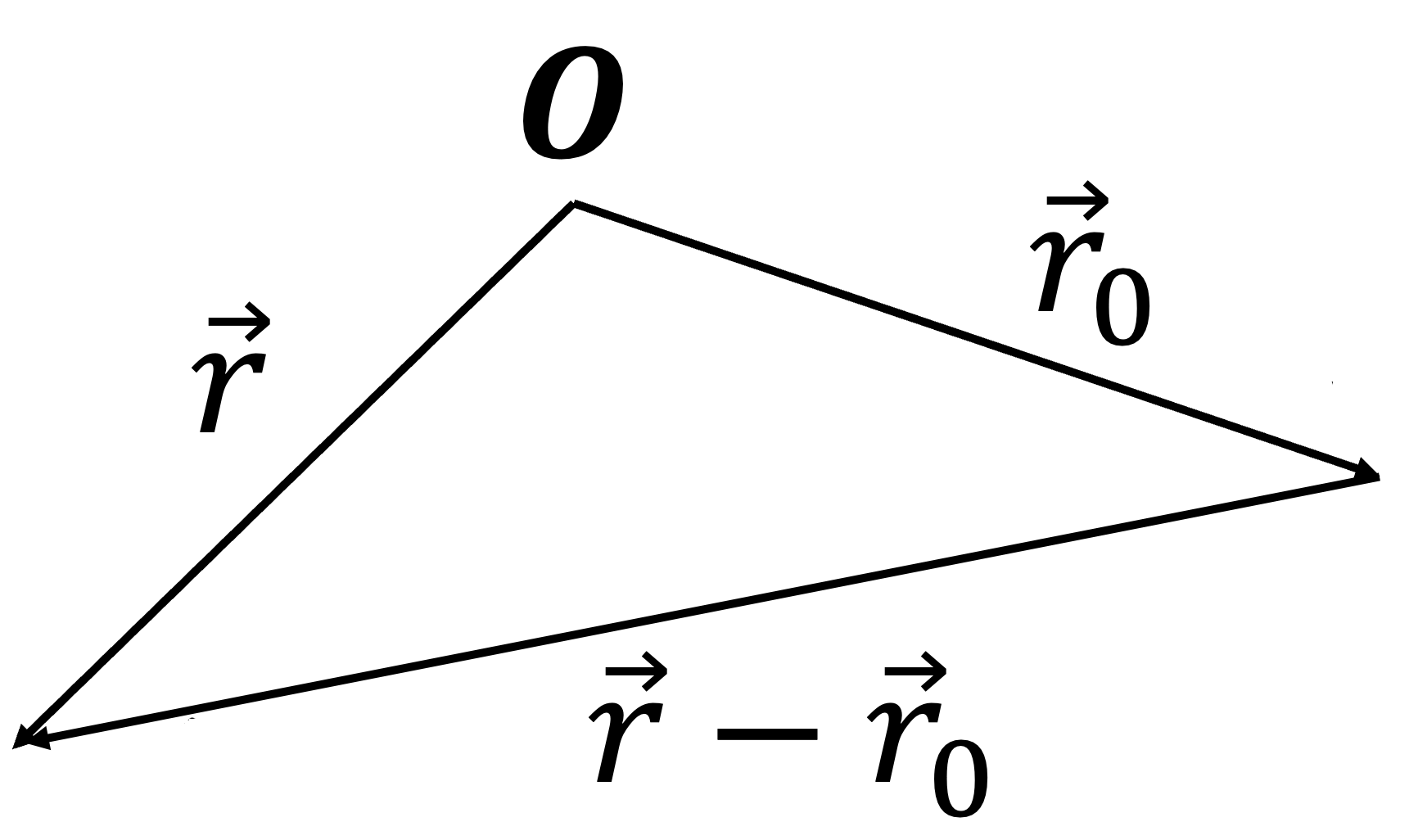
- ☸ Prove that the free space Green's function \(g = e^{-jkR}/4\pi R\) solves the inhomogeneous Helmholtz equation \((\nabla^2 + k^2)f = -\delta(\vec{r} - \vec{r}_0)\), where \(R = |\vec{r}- \vec{r}_0|\). Hint: Integrate the differential equation over the volume of a sphere of radius \(\epsilon\) and use the divergence theorem to convert the volume integral into a surface integral. Evaluate the surface integral and then take the limit as \(\epsilon \to 0\). Also note that \(\int_0^\epsilon e^{-jkR} R dR \to 0 \text{ as } \epsilon \to 0\).
- What is reciprocity in acoustics?
- To determine the condition that makes a medium reciprocal, suppose there are point sources at positions \(\vec{r}_1\) and \(\vec{r}_2\). The free space Green's functions \(G(\vec{r}|\vec{r}_1)\) and \(G(\vec{r}|\vec{r}_2)\) satisfy their respective inhomogeneous Helmholtz equations. Combination of the Helmholtz equations, integration over volume, and application of the divergence theorem leads to \begin{align}\label{vanishitofffthat}\tag{13} \int_{\mathcal{S}} \bigg[G(\vec{r}|\vec{r}_2) \frac{\partial G(\vec{r}|\vec{r}_1)}{\partial n} - G(\vec{r}|\vec{r}_1) \frac{\partial G(\vec{r}|\vec{r}_2)}{\partial n}\bigg] dS &= G(\vec{r}_2|\vec{r}_1) - G(\vec{r}_1|\vec{r}_2)\,. \end{align} Why does the right-hand side of equation (\ref{vanishitofffthat}) equal \(0\)? What are the three conditions on the boundary of surface \(\mathcal{S}\) in which the left-hand side vanishes, thereby satisfying the equality and giving the conditions for a reciprocal medium?
- ☸ Starting with the Helmholtz equation for a point-inhomogeneity,\(\nabla^2 G + k^2 G = -\delta(\vec{r} - \vec{r}_0)\), and for a function-inhomogeneity, \(\nabla^2 p + k^2 p = -f(\vec{r})\), derive the Helmholtz-Kirchhoff integral, \begin{align}\label{HKint}\tag{14} p(\vec{r}) = \int_{\mathcal{V}} f(\vec{r}_0) G(\vec{r}|\vec{r}_0)dV_0 + \oint_\mathcal{S} \bigg[G(\vec{r}|\vec{r}_0) \frac{\partial p(\vec{r}_0)}{\partial n_0} - p(\vec{r}_0)\frac{\partial G(\vec{r}|\vec{r}_0)}{\partial n_0} \bigg]dS_0 \end{align} Outline: Relate the two PDEs by multiplying the point-inhomogeneity PDE by \(p\) and the function-inhomogeneity PDE by \(G\). Subtract, interchange \(\vec{r}\) and \(\vec{r}_0\), integrate over volume, and apply the divergence theorem. Why does the surface integral vanish in free space?
- ☸ Use equation (\ref{HKint}) to derive the Rayleigh integral of the first kind,
\begin{align}\label{Rayleigh integral}\tag{15}
p(\vec{r}) &= \frac{j\omega \rho_0}{2\pi}\oint_\mathcal{S} \frac{e^{-jkR}}{R} u^{(z)}(\vec{r}_0) dS_0
\end{align}
which gives the pressure field due to a velocity source. Let \(\vec{e}_{n0}\) be the unit outward normal, and align the surface source in the plane \(z=0\), as shown below.
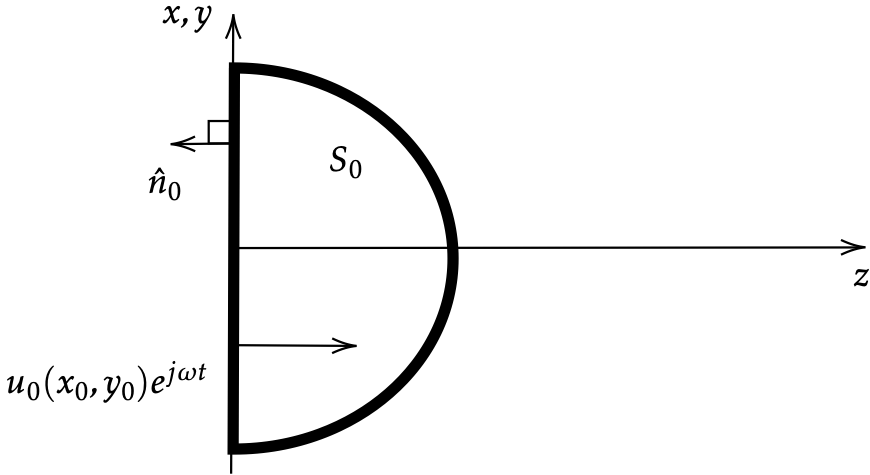 Outline: Let the first integral in equation (\ref{HKint}) be zero, i.e., assume no sources distributed in the volume. With the remaining surface integral, write \(\partial p(\vec{r}_0)/\partial n_0 = -\partial p(\vec{r}_0)/\partial z_0\) in terms of particle velocity using the momentum equation. With the second term, choose \(G\) such that \(\partial G/\partial n_0 = 0\) on the surface. The correct choice (show this) is \(G(\vec{r}|\vec{r}_0) = g_+(\vec{r}|\vec{r}_0) + g_-(\vec{r}|\vec{r}_0)\), where \(g_\pm = e^{-jkR_\pm}/4\pi R_\pm\), where \(R_\pm = \sqrt{(x-x_0)^2 + (y-y_0)^2 + (z\mp z_0)^2}\).
- Use the Rayleigh integral for a velocity source, Eq. (\ref{Rayleigh integral}) to calculate the on-axis (\(x=y=0\)) field due to a uniform circular piston of radius \(a\).
- ☸ Derive the Rayleigh integral of the second kind, \begin{align}\label{Rayleigh integral 2}\tag{16} p(\vec{r}) &= \frac{jkz}{2\pi} \oint p(\vec{r}_0) \bigg(1 + \frac{1}{jkR} \bigg) \frac{e^{-jkR}}{R^2} dS_0\,, \end{align} which gives the pressure field due to a pressure source. Start with equation (\ref{HKint}), and follow the derivation for the first Rayleigh integral, only now choosing \(G(\vec{r}|\vec{r}_0) = g_+(\vec{r}|\vec{r}_0) - g_-(\vec{r}|\vec{r}_0)\). What is this integral called in optics?
- ☸ Obtain the Fraunhofer approximation of the Rayleigh integral of the first kind (\ref{Rayleigh integral}): \begin{align}\label{Fraunhofer}\tag{17} p(\vec{r}) &= \frac{j\omega \rho_0}{2\pi}\frac{e^{-jkr}}{r} \iint_{-\infty}^\infty e^{jk_xx_0 + jk_yy_0} u_0(x_0,y_0) dx_0 dy_0 \end{align} Outline: Expand the squares in the displacement \(R = \sqrt{(x-x_0)^2 + (y-y_0)^2 +z^2},\) identify \(r^2 = x^2+ y^2+z^2\), and take the first-order binomial expansion of \(R\). Multiply by \(k\) to make the quantity dimensionless, and throw out quadratic terms (terms proportional to \(x_0^2,y_0^2\)). Finally, interpret \(k_x \equiv kx/r\) and \(k_y \equiv ky/r\). Do you recognize the resulting 2D integral? At what \(r\) does the Fraunhofer approximation hold?
- What is the \(ka \ll 1\) limit of the Fraunhofer approximation?
- Convert the Fraunhofer approximation, equation (\ref{Fraunhofer}), which is given in terms of rectangular coordinates in the source plane, to polar coordinates in the source plane using the change-of-variables in which \(\kappa = k\sin\theta\), and
\begin{alignat*}{2}
x&= \sigma \cos \psi \qquad y&&= \sigma \sin \psi \\
k_x&= \kappa\cos \phi \qquad k_y&&= \kappa\sin \phi\,.
\end{alignat*}
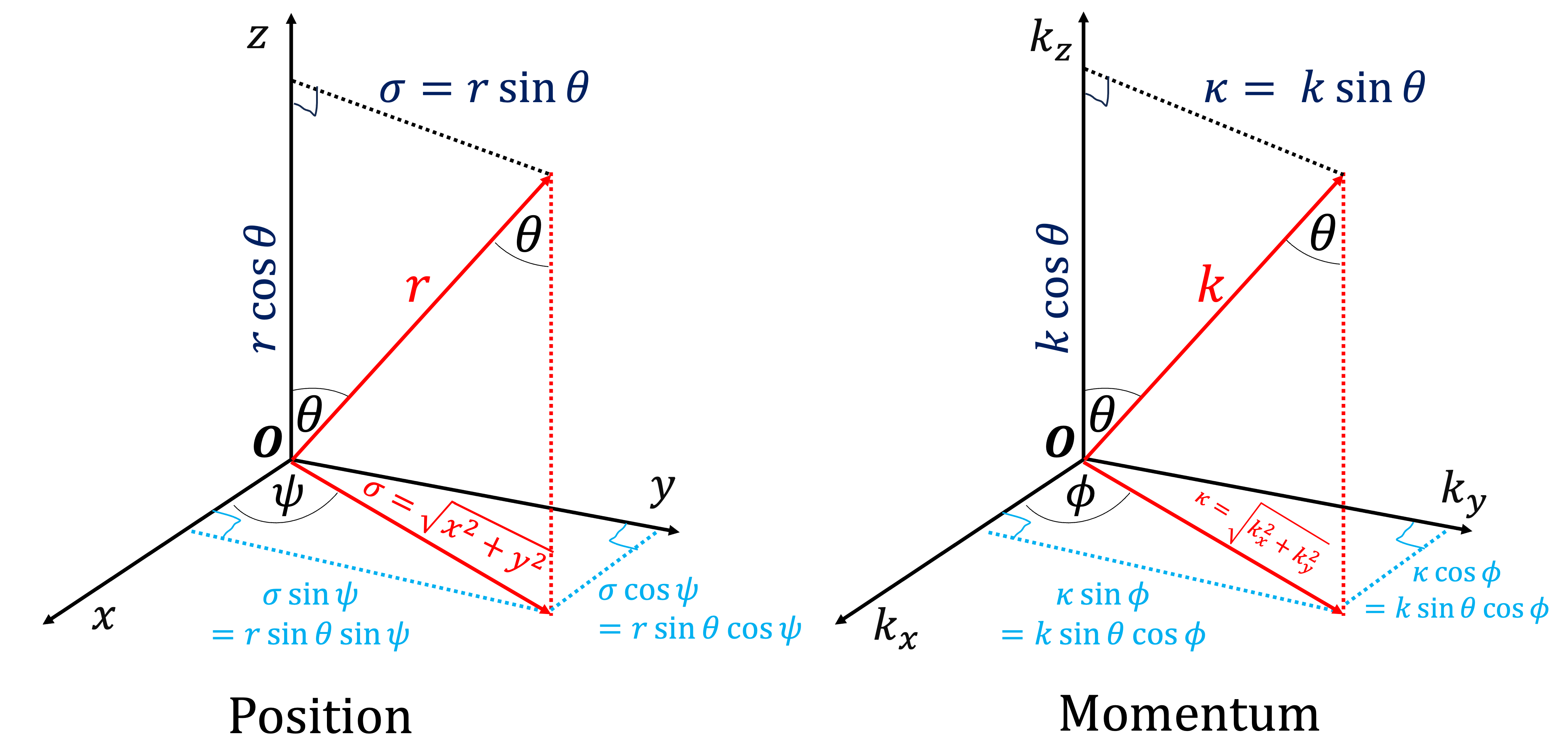 Then simplify the result to the case of an axisymmetric beam (no dependence on \(\psi\)).
- Find the far-field pressure field and directivity due to a thin ring of pressure at \(z=0\) centered about the \(z\) axis, given by the condition \begin{align*} u_0(\sigma) = u_0 w \delta(\sigma-a) \end{align*} where \(\sigma\) is the radial coordinate in the source plane.
- Find the far-field pressure field and directivity due to a uniform circular piston at \(z=0\) centered about the \(z\) axis, given by the condition \begin{align*} u_0(\sigma) = \begin{cases} u_0,\quad \sigma \in [0,a] \\ 0,\quad \sigma > a \end{cases}\,, \end{align*} where \(\sigma\) is defined as before.
- ☸ Obtain the Fresnel (paraxial) approximation of equation (\ref{Rayleigh integral}). The result is \begin{align}\label{Fresnel}\tag{18} p(x,y,z) &= \frac{j\omega \rho_0}{2\pi}\frac{e^{-jkz}}{z}\iint_{-\infty}^\infty \, u_0(x_0,y_0) e^{-jk [(x-x_0)^2 + (y-y_0)^2]/2z}\,dx_0\, dy_0\,. \end{align} Outline: Expand \(R\) in powers of \(1/z\) (whereas in the Fraunhofer approximation, \(R\) was expanded in powers of \(1/r\)). What are the limits on this approximation?
- Does the paraxial approximation depend on \(ka\)? Does the paraxial approximation contain evanescent waves?
- Obtain the axisymmetric form of equation (\ref{Fresnel}), using the rectangular-to-polar mapping \begin{alignat*}{2} x&= \sigma \cos \psi \quad x_0 &&= \sigma_0 \cos\psi_0\\ y&= \sigma \sin \psi \quad y_0 &&= \sigma_0 \sin\psi_0 \end{alignat*} and thus \(dx_0 dy_0 = \sigma_0 d\sigma_0 d\psi_0\). Denote \(\omega \) as \(kc_0\).
- How does one include spherical focusing in the Fresnel approximation? Let the focal length be \(d\). Then a spherical wavefront is proportional to \(e^{jk\sqrt{x^2 + y^2 + (z-d)^2}}/\sqrt{x^2 + y^2 + (z-d)^2}\). Let the aperture \(a/d\) be small, where \(a\) is the source radius.
- In the paraxial approximation, the field in the focal plane of a focused source is given by the ________ transform of the source condition in cartesian coordinates and the ________ transform in polar coordinates. Why is this?
- Derive the paraxial wave equation, \[-j2k\frac{\partial q}{\partial z} + \nabla^2_\perp q= 0\,,\] where \(\nabla^2_\perp\) is the transverse Laplacian, \(\partial/\partial x^2 + \partial/\partial y^2\) in Cartesian coordinates. Start with the Helmholtz equation, \(\nabla^2 p + k^2 p = 0\), and let \(p(x,y,z) = q(x,y,z)e^{-jkz}\). Note that \(\partial^2 q/\partial z^2 \ll 1\).
- State Babinet's principle.
- The \(i(kx-\omega t)\) convention is adopted for this problem. Use the 2D Fourier transform pair \(\hat{f}(k_x,k_y) = \iint_{-\infty}^\infty f(x,y) e^{-i(k_xx+ k_yy)\,dxdy}\) and \({f}(x,y) = (2\pi)^{-2}\iint_{-\infty}^\infty \hat{f}(k_x,k_y) e^{i(k_xx+ k_yy)\,dk_xdk_y}\) to solve the Helmholtz equation in terms of the source condition \(p(x,y,z=0)\). Hint: note that the Fourier transform of the \(n^\mathrm{th}\) derivative of \(f\) with respect to \(x\) is \((ik_x)^n \hat{f}(k_x,k_y)\), and that the \(n^\mathrm{th}\) derivative of \(f\) with respect to \(y\) is \((ik_y)^n \hat{f}(k_x,k_y)\). Use these relations to reduce the Helmholtz equation to an second-order ordinary differential equation in \(z\). How does the solution change for a velocity source?