Chapter 12: Waveguides
- Find the eigenmodes, cutoff frequency, phase speed, and group speed for an infinite rectangular duct of length \(a\) and height \(b\), where \(\partial p/\partial x = 0\) from \(x \in [0,a]\) and \(\partial p/\partial y = 0\) from \(y \in [0,b]\). For what drive frequencies \(\omega\) does the sound propagate? Why does the drive frequency \(\omega\) not bear the indices of the modes?
- Find the eigenmodes, cutoff frequency, phase speed, and group speed for an infinite cylindrical duct of radius \(a\), where \(\partial p/\partial r = 0\) at \(r=a\). For what drive frequencies \(\omega\) does the sound propagate? Why does the drive frequency \(\omega\) not bear the indices of the modes?
- ☸ Calculate the pressure field due to a baffled circular piston of radius \(b\) positioned with its center on the axis of a cylindrical tube of radius \(a\).
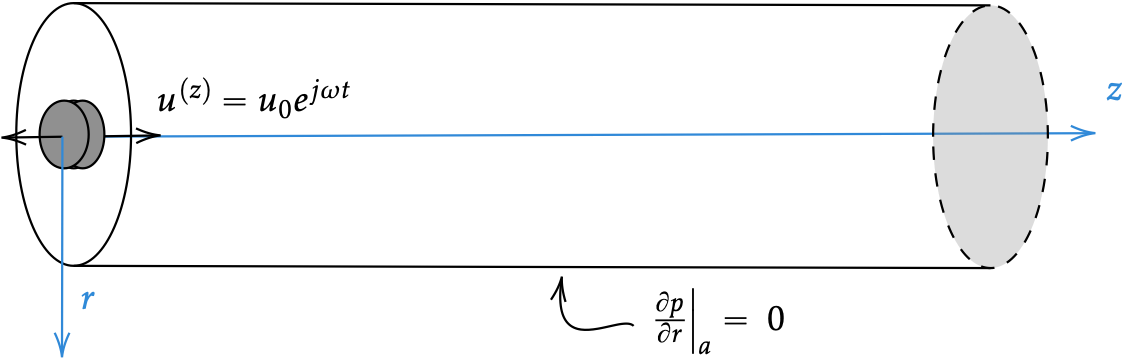 The boundary conditions at \(z=0\) are
\begin{alignat*}{2}
u_z &= u_0 e^{j\omega t},\quad &&r\in [0,b]\\
u_z &= 0,\quad &&r\in (b,a]
\end{alignat*}
and \(\partial p/\partial r = 0\) at \(r=a\) for all \(z\). Note that \[\int_0^1 J_m(\alpha'_{mn} x )J_m(\alpha'_{mn'} x) \,x\, dx = \frac{1}{2}[1-(m/\alpha'_{mn})^2] J^2_m(\alpha'_{mn'}) \delta_{nn'}\]
is the orthogonality integral.
The boundary conditions at \(z=0\) are
\begin{alignat*}{2}
u_z &= u_0 e^{j\omega t},\quad &&r\in [0,b]\\
u_z &= 0,\quad &&r\in (b,a]
\end{alignat*}
and \(\partial p/\partial r = 0\) at \(r=a\) for all \(z\). Note that \[\int_0^1 J_m(\alpha'_{mn} x )J_m(\alpha'_{mn'} x) \,x\, dx = \frac{1}{2}[1-(m/\alpha'_{mn})^2] J^2_m(\alpha'_{mn'}) \delta_{nn'}\]
is the orthogonality integral.
- ☸ Write the spinning mode eigenfunction of the wave equation that has a spiral wavefront. What is the relationship between a spinning mode and a vortex beam? What is the equation for surfaces of constant phase? What is the angular velocity of each mode? What is \(m\) called?
- ☸ Provide a physical interpretation for the phase speed, cutoff frequency, and group speed in a waveguide. Hint: It is easiest to think of a two-dimensional waveguide for this discussion.
Think of rectangular drumhead that is clamped at \(y=0\) and \(y=d\), and that is infinite in the \(x\) direction. Let \(\theta_i\) be the angle of an incident ray, and let the wavelength of the incident ray be \(\lambda_i\), as in Blackstock's figure 6.14:
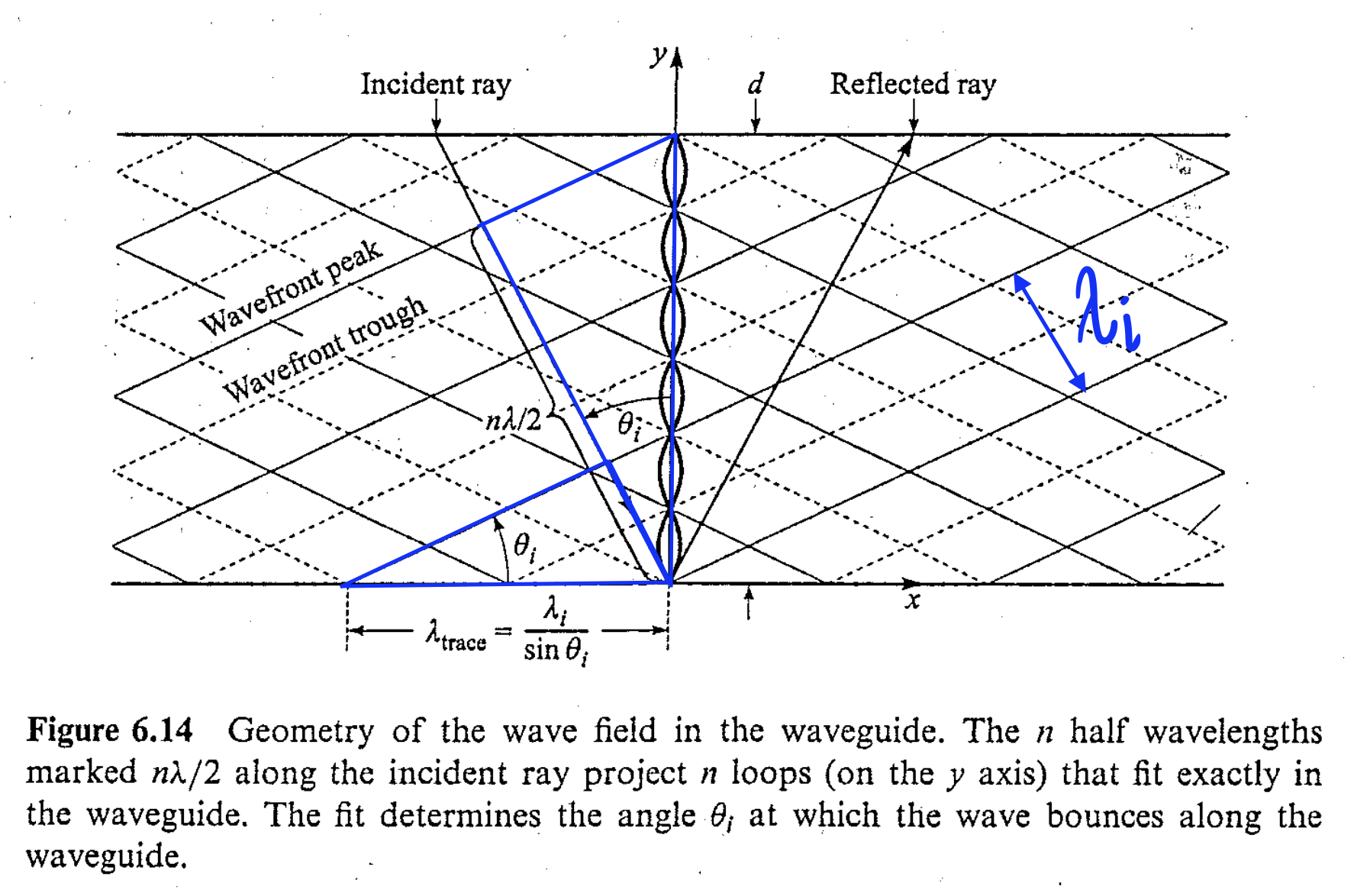
Then, the component of this wavelength on the \(x\) axis is \(\lambda_\text{trace} = \lambda_i/\sin\theta_i\). The speed at which this projection travels is \[c_n^\text{ph} = f\lambda_\text{trace} = \frac{f\lambda}{\sin\theta_i} = \frac{c}{\sin\theta_i} = \frac{c}{\sqrt{1-\cos^2\theta_i}}.\] The superposition of the incident and refleted wave creates a vertical standing wave pattern that has \(n\) loops. From geometry, the \(n\) loops have a projection of \(n\lambda/2\) wavelengths on the incident ray. That is, \(\cos\theta_i = n\lambda/2d = nc/2fd.\) Thus the phase velocity is \[c_n^\text{ph} = \frac{c}{\sqrt{1-(nc/2fd)^2}}.\]
Therefore, for a given \(n\), as the wavelength is increased, \(\theta_i\) becomes smaller and smaller so as to maintain that \(n\) loops are fit about the \(y\) axis. (Think about that limit by making the distance between crests larger. Then the fact that \(\theta_i\) decreases to maintain the location of the nodes will be clear).
As \(\theta_i\) approaches \(0\), lines of constant phase sweep the entire \(x\) axis, and thus the phase speed goes to \(\infty\). (Qualitatively, this makes sense, because lines of constant phase will reach \(x = \pm \infty\) instantaneously; quantitatively this can be seen from the fact that \(c_n^\text{ph} = {c}/{\sin\theta_i}\)). The wavelength for which \(\theta_i = 0\) corresponds to the cutoff frequency. Below this frequency, the sound cannot fit the same \(n\) loops in the vertical direction. Therefore, the sound just cannot live with itself. It kills itself off as an evanescent wave.
Meanwhile, the physical meaning of the group speed is the projection of the wave velocity along the principal axis of the waveguide: \(c^\text{ph}_n = c\sin\theta_i\).
- In what frequency limit does the phase speed \(c_\text{ph}\) in a waveguide appoach the speed of sound in free space, \(c\)?
- What is the phase speed at a cutoff frequency?