Note that Blackstock's convention is used in the following discussion.
In spherical coordinates, \(n = 0,1,2,\dots\) corresponds to the order of the spherical Bessel function. \(n\) also appears as the index of the Legendre polynomial and the lower index of the associated Legendre function. Meanwhile, \(l = 1,2,3,\dots\) corresponds to the zero of the spherical Bessel function. Finally, \(m = 0, 1,2,\dots, n\) appears in the harmonic azimuthal dependence, as well as in the top index of the associated Legendre polynomial. The eigenfrequencies in spherical coordinates depend only on \(n\) and \(l\) in even the most general case.
In cylindrical coordinates, \(m = 0,1,2,\dots\) is the order of the Bessel function, while \(n = 1,2,3,\dots\) corresponds to the zero of the Bessel function. \(m\) is also the index corresponding to the harmonic polar dependence. \(l = 1,2,3,\dots\) (and sometimes \(0\)) is the index corresponding to the \(z\)-dependence. The eigenfrequencies in cylindrical coordinates depend on all three indices in the most general case.
One similarity between spherical and cylindrical solutions is that the Bessel functions and polar functions in either case share the same index. In spherical coordinates, that index is \(n\); in cylindrical coordinates, that index is \(m\). In light of this, I wish Dr. Blackstock had used \(n\) instead of \(m\) for the index in cylindrical coordinates, to preserve this similarity with spherical coordinates.
One difference between spherical and cylindrical solutions is that \(n\) in spherical coordinates is necessarily an integer, but \(m\) in cylindrical coordinates can taken on non-integer (and in fact irrational) values. This happens in cylindrical wedge problems. In this case, the Latin \(m\) is replaced with the Greek \(\mu\).
One should not be militant about the names of indices; it is much more important to have the form of solution correct. In summary, the general solution in spherical coordinates is given by
\begin{align*}
R(r)\Theta(\theta)\Psi(\psi)= \begin{Bmatrix}j_n(k_{nl}r) \\n_n(k_{nl}r)\end{Bmatrix} \begin{Bmatrix}P^m_n(\cos\theta) \\ Q^m_n(\cos\theta)\end{Bmatrix} \begin{Bmatrix}\cos m\psi \\ \sin m\psi \end{Bmatrix}\begin{Bmatrix}\cos \omega t \\ \sin \omega t\end{Bmatrix}
\end{align*}
while that in cylindrical coordinates is given by
\begin{align*}
R(r)\Theta(\theta)Z(z)= \begin{Bmatrix}J_m(k_{mn}r) \\N_m(k_{mn}r)\end{Bmatrix} \begin{Bmatrix}\cos m\theta \\ \sin m\theta\end{Bmatrix} \begin{Bmatrix}\cos lz \\ \sin lz\end{Bmatrix}\begin{Bmatrix}\cos \omega t \\ \sin \omega t\end{Bmatrix}
\end{align*}
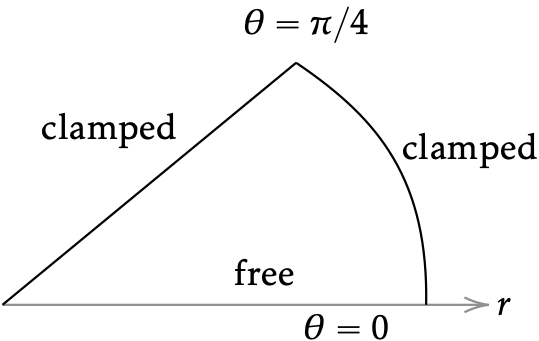 Find the eigenfrequencies and identify the lowest one. Part 2. Suppose there is an initial displacement on the membrane of \(\eta_0\), which would correspond to a "plucked" initial condition. Also assume there is no initial velocity:
\begin{align*}
\eta(r,\theta,0) &=
\begin{cases}
\eta_0,\quad &\theta = [0,\,\pi/4),\, r = [0,a]\\
0,\quad &\theta = [\pi/4,\, 2\pi)
\end{cases}\\
\dot{\eta}(r,\theta,0) &= 0
\end{align*}
Apply the initial condition to the eigenfunctions found in part 1 to find \(C_{mn}\) and \(D_{mn}\). Leave the relevant expansion coefficients in integral form, and evaluate the integral for \(m=0\) only. Compare the coefficients for \(m=0\) to Blackstock's equation (11.B-13) on page 400 for a circular drumhead clamped at \(r=a\) subject to the analogous "plucked'' initial condition.
Find the eigenfrequencies and identify the lowest one. Part 2. Suppose there is an initial displacement on the membrane of \(\eta_0\), which would correspond to a "plucked" initial condition. Also assume there is no initial velocity:
\begin{align*}
\eta(r,\theta,0) &=
\begin{cases}
\eta_0,\quad &\theta = [0,\,\pi/4),\, r = [0,a]\\
0,\quad &\theta = [\pi/4,\, 2\pi)
\end{cases}\\
\dot{\eta}(r,\theta,0) &= 0
\end{align*}
Apply the initial condition to the eigenfunctions found in part 1 to find \(C_{mn}\) and \(D_{mn}\). Leave the relevant expansion coefficients in integral form, and evaluate the integral for \(m=0\) only. Compare the coefficients for \(m=0\) to Blackstock's equation (11.B-13) on page 400 for a circular drumhead clamped at \(r=a\) subject to the analogous "plucked'' initial condition.